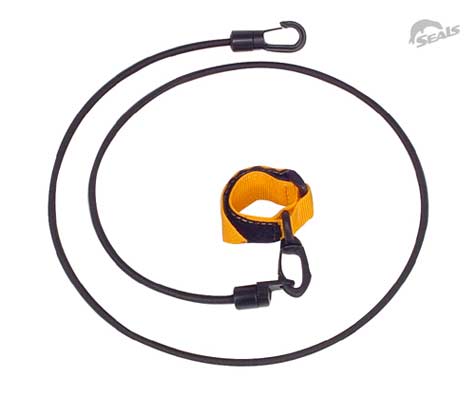
Paddle Leash -Seals
Fifteen dollars against the cost of your paddle, and against the much worse problem of being in a boat without one. A kayak paddle leash is the least glamorous thing we sell and one of the few we think almost everybody should own.
What Actually Goes Wrong
You lean over to unhook a fish and put the paddle down across your lap. A wake comes through. Or you capsize, and in the second of confusion the paddle goes one way and the boat goes the other — and a kayak on its side catches wind and moves across the water faster than you can swim after it while holding a paddle.
A leash means the paddle and the boat stay together. That is the whole idea, and it is why guides insist on them.
Where a Kayak Paddle Leash Helps Most
Fishing, without question. Any time you are putting the paddle down to do something else with your hands, you want it tethered. Photography is the same. So is anything in current or wind, where a dropped paddle is gone in seconds rather than minutes.
It clips to your deck rigging at one end and around the paddle shaft at the other.
The Honest Caveat
A leash in moving water is a snag hazard. In surf, in whitewater, or in strong tidal current, a line running between you and a floating object is something that can wrap a limb or catch a fitting at the worst moment. That is why sea kayak instructors are split on them.
For flat inshore water around Clearwater — the flats, the bays, the mangrove creeks, where most of our customers paddle — a paddle leash is straightforwardly a good idea. For surf or fast water, think about it properly and ask us first. We will give you a straight answer rather than just selling you one.
Details
• Kayak paddle leash
• Attaches to deck rigging and paddle shaft
• Keeps paddle and boat together if you go over or set the paddle down
• This is the basic Seals leash, not the Deluxe model
We keep them at the counter in our Clearwater shop.